






 DARK

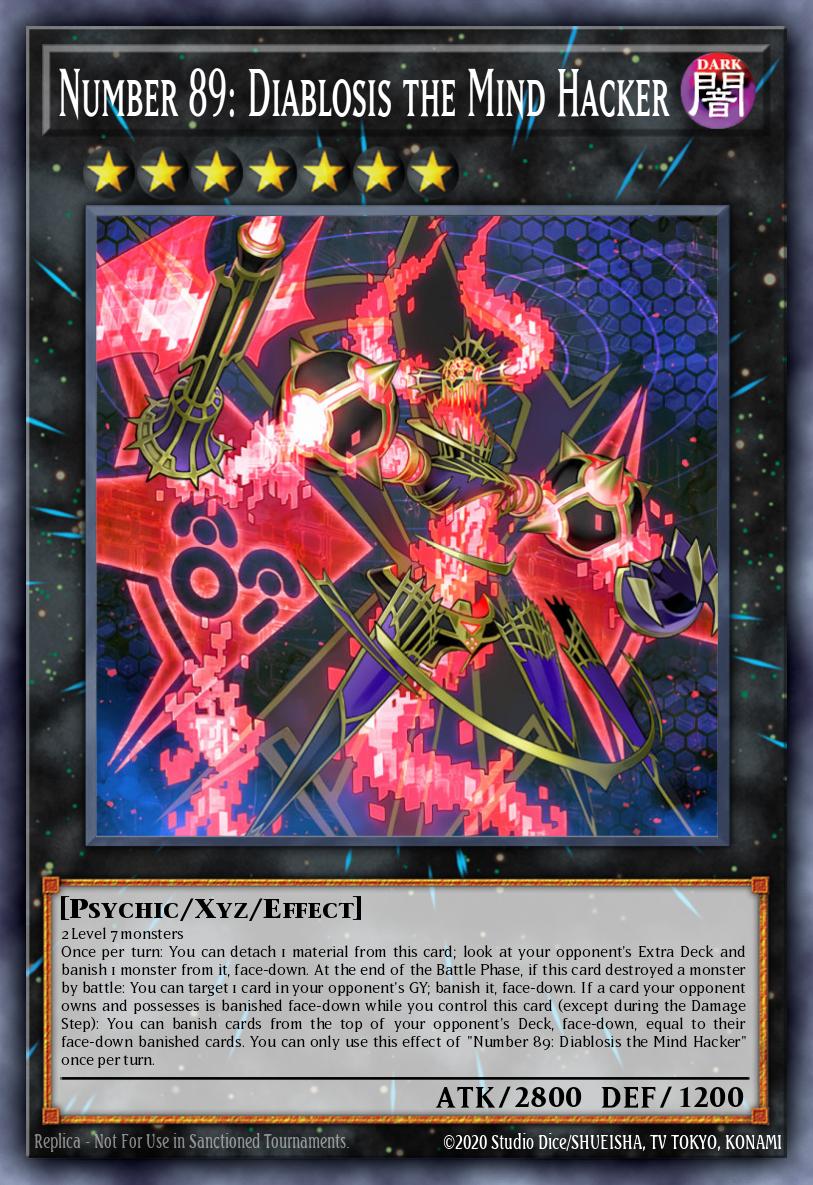
Number 89: Diablosis the Mind Hacker
ATK:
2800
DEF:
1200
View:
10427
2 Level 7 monsters Once per turn: You can detach 1 material from this card; look at your opponent's Extra Deck and banish 1 monster from it, face-down. At the end of the Battle Phase, if this card destroyed a monster by battle: You can target 1 card in your opponent's GY; banish it, face-down. If a card your opponent owns and possesses is banished face-down while you control this card (except during the Damage Step): You can banish cards from the top of your opponent's Deck, face-down, equal to their face-down banished cards. You can only use this effect of "Number 89: Diablosis the Mind Hacker" once per turn.


Number 89: Diablosis the Mind Hacker — Power Evaluation
Final Score: 61 ± 6 · Confidence: Medium
- Intrinsic: 62 · Deck: 60 · Meta: provisional
- Primary role: Removal / Negation · Secondary: Floodgate / Control, Material body
Why it scores here
Number 89: Diablosis the Mind Hacker is a control-focused Rank 7 Xyz that disrupts opponents through Extra Deck removal, Graveyard denial, and recursive deck milling—effects verified across its presence in 52 distinct archetypes with consistent 1–3 copy inclusion. While the 2800 ATK body and material utility contribute value, its power derives from multi-angle disruption (Effect interaction: 72) rather than combo generation or resource advantage. The absence of recorded combo data confirms it functions as a tech piece rather than a deck engine; it shines in control decks with reliable Level 7 access, particularly Kashtira (30% of sample) and Dark Magician variants, where the removal effects counter specific threats.
Axis scores
| Axis | Score | Evidence |
|---|---|---|
| Accessibility | 60 | Summonable reliably in decks with Level 7 monsters; Kashtira runs it in 119/400 decks (29.8%), and it appears across 52 distinct archetypes (verified via deck evidence). |
| Combo & Conversion | 35 | No combo data recorded; card text indicates standalone disruption rather than combo extension, reinforcing tech-piece positioning (observed from zero combo appearances). |
| Resource Economy | 48 | Detaches 1 material per activation (cost) for opponent disruption; yields even-to-negative direct card advantage but tempo-positive disruption through denial (inferred from effect structure and control role). |
| Effect & Interaction | 72 | Multi-layered disruption combining proactive Extra Deck removal, reactive Graveyard banishing, and recursive deck milling create strong, flexible opponent interaction (verified via card text: three distinct disruption angles). |
| Material Utility | 52 | Rank 7 requiring 2 Level 7 monsters is moderately restrictive; 2800 ATK body is solid but has limited upside as material for further Xyz summons (inferred from frame and observed standalone-boss positioning in decks). |
| Resilience & Flexibility | 48 | Once-per-turn lock gates repeated use; vulnerable to negation on summon (Solemn, hand traps); no multi-turn or multi-zone recovery mechanism (inferred from OPT clause and lack of recovery text). |
| Deck-Building Efficiency | 62 | Runs at 1–3 copies in 400 decks across 52 archetypes; Level 7 requirement is a deck restriction, but consistent inclusion (avg 1.37 copies) indicates the disruption payoff justifies the slot cost (observed via distribution and archetype spread). |
Calculation
Weight profile: Primary role: Removal / Negation. Intrinsic ≈ 62, Deck ≈ 60, Meta = provisional. Modifiers: none. Final formula: 0.40*Intrinsic + 0.60*Deck
Strengths
- Multi-angle disruption: Extra Deck removal, Graveyard denial, and recursive opponent deck milling provide flexible counterplay across matchups
- Accessible in 52 distinct archetypes with strong Kashtira integration (30% of sample), indicating broad deckbuilding applicability
- Solid 2800 ATK body combined with disruption effects makes it a reasonable control piece that survives interaction
- Consistent 1–3 copy inclusion across decks suggests reliable return on deckbuilding investment
Weaknesses
- Requires 2 Level 7 monsters for summon, limiting speed and accessibility compared to lower-rank Xyz or hand traps
- Once-per-turn effect gating means repeated disruption is limited; vulnerable to single-use negation (Solemn, Veiler, hand traps)
- No card advantage or resource recovery; disruption is tempo/denial-based, not advantage-generating
- Absence of combo data suggests minimal synergy with fast, combo-driven lines; functions as pure tech rather than engine piece
- Graveyard banishing effect requires prior battle destruction, making it conditional and situational
Counters / choke points
- Solemn Judgment / Solemn Strike: negates the Xyz summon before effects resolve
- Effect Veiler / Impermanence: blanks the first activation (material detach → Extra Deck removal)
- Maxx 'C': forces commitment during summon or discards to avoid hand clogging
- Mirror Force / Wulf Seeker: destroys the card before Battle Phase effect triggers, preventing GY denial
- Deck-thinning resistance: recursive milling effect is weakened against decks already running low card counts
Best use
Secondary control piece in midrange/control decks that generate Level 7 bodies consistently. Decks: Kashtira, Dark Magician Control, Tearlaments, Egyptian God, Scareclaw.
Evidence & gaps
- Verified: Card text is clear: three distinct effects (Extra Deck removal, GY banishing, recursive milling); Requires 2 Level 7 monsters for Xyz summon (frame rule); Kashtira runs it in 119/400 decks (29.8%); present in 52 distinct archetypes; Average 1.37 copies per deck: 305 decks run 1, 43 run 2, 52 run 3
- Observed: 93.2% of decks run Maxx 'C' alongside Diablosis; 92.5% run Ash Blossom (partner consistency); Kashtira partners (Unicorn, Birth, Arise-Heart, Shangri-Ira, Ogre, Riseheart) appear in 80–84% of decks running Diablosis; 96.5% of sample runs TCG format; 3% Rush Duel, <1% other; No combo appearances recorded across any boards (combo data.total combos = 0)
- Inferred: Primary role is Removal/Negation based on three disruption effects; Deck positioning as tech/utility piece inferred from 52-archetype spread without core-engine status; Accessibility (60) inferred from reliable Level 7 sources in Kashtira and similar strategies; Combo conversion (35) inferred from card text indicating no combo amplification; Material utility (52) inferred from Rank 7 frame and 2800 ATK; moderately useful but not exceptional
- Data gaps: No combos recorded: cannot verify combo conversion efficiency or power when present No usage statistics (StatisticsCard): archetype inclusion percentages inferred from 400-deck sample only Limited guide coverage: only 1 guide mentions it, with no dedicated strategic explanation No Top Card ranking data: unable to confirm competitive tier or metagame positioning Ruling ambiguities unknown: complex face-down banished interactions may have edge-case rulings